
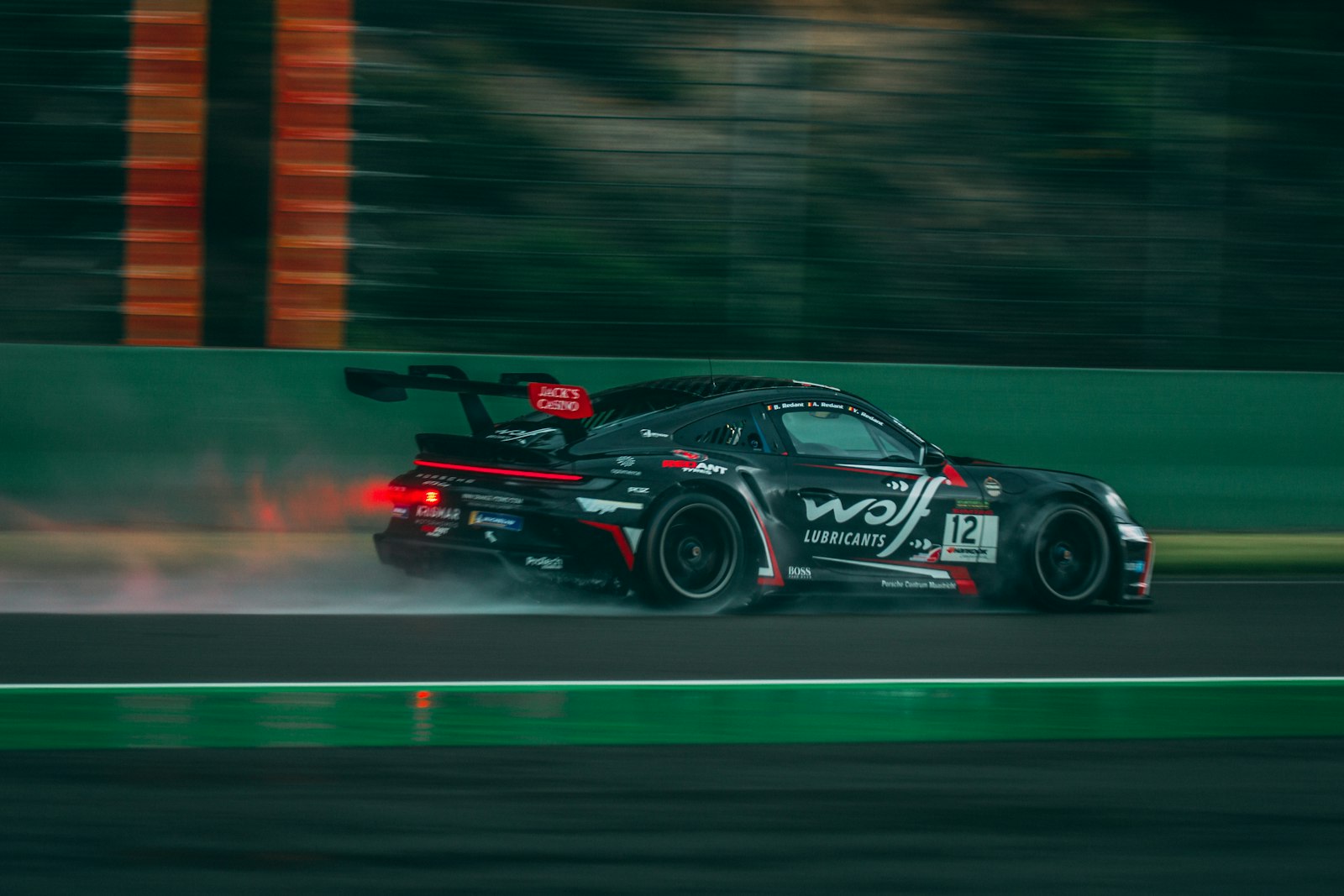
If you asked a casual fan where a Formula 1 car gets its grip, most would point at the wings. The big front wing, the rear wing, the bits that obviously look like aeroplane parts turned upside down. They are not wrong, exactly — the wings matter — but they are pointing at the wrong end of the problem. On the current generation of cars, the majority of the downforce, the invisible force that pushes the car into the road and lets it corner at speeds that should be impossible, comes from underneath. It comes from the floor.
This is the part of the car the broadcast never shows you, because it is two centimetres off the ground and pointed at the tarmac. It is also the part the engineers care about more than almost anything else. So let me try to explain it the way I would explain it to a friend in the paddock who does not happen to be an aerodynamicist — without the hype, and without pretending it is simpler than it is.
What ground effect actually is
The principle is over a century old and it has a name you half-remember from school: Bernoulli. When air speeds up, its pressure drops. That is the whole trick. The underside of a Formula 1 car is shaped so that the gap between the floor and the road forms a sort of tunnel — technically a pair of tunnels called Venturi channels — that narrows and then expands. Air rushing through the narrow part is forced to accelerate, its pressure drops, and you end up with a region of low pressure underneath the car and normal atmospheric pressure on top. The car is, in effect, sucked downward by the difference. That suction is ground effect.
The reason this matters so much is efficiency. A wing makes downforce by deflecting air, and deflecting air always costs you drag — it is a tax you pay in straight-line speed. The floor makes downforce by accelerating air through a shaped channel, and it does so for a tiny fraction of the drag. Downforce from the floor is, pound for pound, far cheaper than downforce from the wings. That is why the current regulations were written around it: the sport wanted cars that could follow each other closely, and floor-generated downforce is less disturbed by the wake of the car in front than wing-generated downforce is. Closer racing, better overtaking — that was the theory.
The catch, and the noise it made
Ground effect has a vicious flaw, and the sport rediscovered it the hard way when these regulations arrived. The lower the floor runs to the ground, the stronger the suction — right up until the airflow through the tunnel chokes and the downforce collapses, all at once. When that happens the car suddenly rises a few millimetres, the floor is no longer sealing, the downforce comes back, the car drops again, and the cycle repeats several times a second. The car bounces violently down the straights. The drivers called it the trampoline. The engineers called it porpoising — named for the way a porpoise rises and dips through water — and it was genuinely dangerous, shaking drivers hard enough to bruise their backs and blur their vision at over 300 km/h.
The fix was partly regulatory and partly developmental. The rulemakers raised the floor edges slightly and mandated a stiffer floor to stop it flexing into the resonance. The teams, for their part, spent enormous effort learning to run the car in a stable aerodynamic window — close enough to the ground to make the downforce, far enough away that the airflow never chokes. That window is narrow, and finding it is most of the job. A car that has tamed its porpoising can run lower, and running lower means more downforce, which means more grip, which means lap time. The teams that solved it early won championships. The teams that did not spent a season fighting their own floors.
Why a small floor change is worth a tenth
This is the question I get asked most, usually with a note of disbelief: how can a change you can barely see with the naked eye — a reshaped floor edge, a slightly different fence, a millimetre here or there — be worth a tenth of a second a lap? A tenth sounds tiny. Over a season it is the difference between fighting for a championship and fighting for sixth.
The answer is that the floor is a system, and you are not changing one thing, you are changing the behaviour of the whole flow structure. The leading edges of the floor and the little vertical fences along its sides do a specific job: they spin up tightly wound vortices — cores of fast-rotating air — that run down the edge of the floor and act like an aerodynamic skirt. They seal the low-pressure tunnel from the higher-pressure air outside, the way a rubber seal keeps the vacuum in. The stronger and more stable those edge vortices are, the better the seal, the lower the pressure under the floor, and the more the car is sucked to the road.
So a floor-edge revision that makes those vortices a little stronger, or keeps them attached a little longer when the car rolls into a corner, improves the seal across the entire cornering range. You are not adding a tenth at one point on the lap. You are adding a small, consistent slice of downforce through every medium and high-speed corner on the circuit, and those slices add up. Multiply a marginally better seal across a dozen corners and you have your tenth. That is why the floor is where the development war is fought.
How teams actually develop it
The process is more methodical and less romantic than people imagine. It runs on three tools, in roughly this order:
- CFD — computational fluid dynamics, which is simulating the airflow inside a computer. It is cheap and fast, you can try hundreds of floor variations a week, and the regulations cap how much of it each team is allowed to do, deliberately, to control costs. Most ideas live and die here.
- The wind tunnel — a scale model on a moving belt with smoke and pressure sensors, used to validate the handful of CFD ideas that survived. The tunnel is also rationed by regulation, and the allocation is weighted so that the team leading the championship gets the least tunnel time — a deliberate handbrake to keep the field close.
- The track — the only place that tells the truth. A new floor goes on the car with a metal grid of pressure-sensitive paint or an array of flow sensors, the car does an installation run, and the engineers compare what the real airflow did against what CFD and the tunnel predicted. The gap between prediction and reality is called correlation, and a team's whole development rate depends on how good its correlation is.
When you hear that a team has brought a floor upgrade to a particular grand prix, this is the chain that produced it: an idea in CFD, validated in the tunnel, confirmed on track, often months apart. And when a rival brings a floor upgrade that does not work — which happens constantly, and quietly — it almost always means their correlation lied to them, that the floor behaved differently in the real airflow than the model promised. That is the most expensive kind of failure in the sport, and it is invisible from the grandstand.
The part the cameras can't sell
None of this makes for good television, which is precisely why I think it is worth writing about. The wings photograph well; the floor does not. But if you want to understand why one car is a tenth quicker than another that looks identical, the honest answer is almost never something you can see on the broadcast. It is a flow structure two centimetres off the road, sealed by a vortex you will never photograph, developed over months by people who measure their success in fractions of a percent. The floor is not a part of the car. On these regulations, the floor is the car.